拍品编号:PMJG4750
拍品名称:LAMA RINPOCHE SANGYE DRAKPA
拍品年代:16th
拍品尺幅:45 * 33(厘米)
成交金额:
1,528,000 HKD
折合人民币:1528000 HKD
拍品类型: 彩唐
拍品地域:西藏
拍品材质:布
拍品主题:人物
拍卖公司:Bonhams(邦瀚斯)
拍卖专场:Reverence(2025-11)
拍卖时间:2025年11月
拍卖地点:香港
原始编号:817
内容:
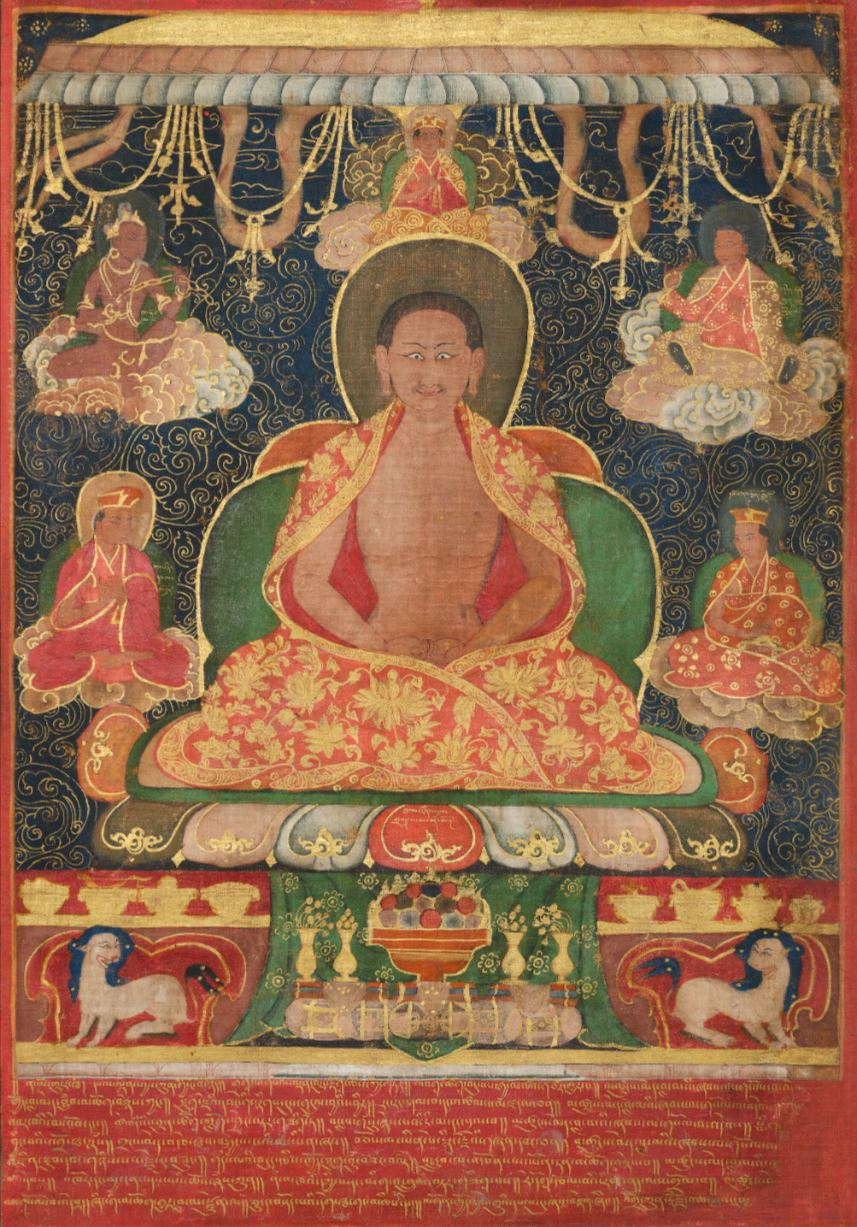
A PORTRAIT THANGKA OF LAMA RINPOCHE SANGYE DRAKPA
TIBET, PROBABLY COMMISSIONED FOR RIWOCHE MONASTERY, CIRCA 1525
Distemper on cloth; with original taupe cloth mounts and red lacquered, gold painted dowel rod; verso with lengthy Tibetan inscriptions in gold against a red ground arranged into the form of a stupa; recto with short Tibetan inscriptions in gold identifying each of the figures and a lengthy dedication to the central figure below the painting.
Image: 45 x 33 cm (17 3/4 x 13 in.);
With silks: 74.3 x 34.5 cm (29 1/4 x 13 1/2 in.)
Footnotes
Published
Matthew Kapstein, "Portrait of an Unknown Adept: An Inscribed Scroll-painting of Bla ma Rin po che Sangs rgyas grags pa." In Gateways to Tibetan Studies: A Collection of Essays in Honour of David P. Jackson on the Occasion of his 70th Birthday, eds. Caumanns, Volker, Jorg Heimbel, Hazuo Kano, and Alexander Schiller (Hamburg: Universität Hamburg, 2021): pp. 543-568.
Jane Casey, Taklung Painting: A Study in Chronology (Chicago: Serindia Publications, 2023), pp. 580-583 and pp. 884-895.
Provenance
Acquired in 2003
Twenty-two years in the Collection of Ulrich von Schroeder
西藏 或為類烏齊寺訂製 約1525年 桑傑札巴仁波切肖像唐卡
著錄
Matthew Kapstein,「Portrait of an Unknown Adept:An Inscribed Scroll-painting of Bla ma Rin po che Sangs rgyas grags pa」,出版於《Gateways to Tibetan Studies:A Collection of Essays in Honour of David P. Jackson on the Occasion of his 70th Birthday》,Caumanns,Volker,Jorg Heimbel,Hazuo Kano,及 Alexander Schiller 編(漢堡:漢堡大學,2021年),頁543-568
Jane Casey,《Taklung Painting:A Study in Chronology》(芝加哥:Serindia Publications,2023年),頁580-583及884-895
來源
2003年入藏
烏爾里希·馮·施羅德珍藏,二十二年
A Important Portrait of Lama Rinpoche Sangye Drakpa Probably Commissioned for Riwoche Monastery
by Jane Casey
This singular painting represents Lama Rinpoche Sangye Drakpa, a disciple of Twelfth Taklung Abbot Ngawang Drakpa Pelzangpo (1418-1496) and of his successor, Thirteenth Taklung Abbot Namgyal Drakpa Pelzanpo (1469-1530). It is likely to have been commissioned at Riwoche monastery in Kham. The central figure appears in the guise of a yogi, bare-chested, hands held in meditation at the lap, eyes wide-open in a powerful gaze. A luxurious orange robe, adorned with golden blossoms and hemmed with a golden scrolling vine, covers the shoulders and the folded legs. A green bolster supports the figure's torso against an orange throneback. An opened lotus, with multi-colored petals highlighted in golden upturned edges, provides a seat for the adept, and a gold-capped canopy bedecked with golden pendants shields the figure from above. His teacher, the Twelfth Taklung abbot Ngawang Drakpa Pelzangpo, appears above his head, floating on a cloud. Four additional figures include the great adept and iron bridge builder Thangton Gyalpo (1385-1481 or 1361-1485), the Treasure-finder Kunkyong Lingpa (1396-1477 or 1408-1489), and two monastic figures who are identified by inscriptions but whose biographies are unknown.[[1]]
Beneath the enthroned figure are offering vessels in front of a throne cloth, with two lions guarding the interstices. Below is a lengthy inscription in gold cursive script. The seven-stanza inscription pays homage to the teacher Sangye Drakpa and dedicates merit for his longevity.
"By whatever virtue is gained by this little praise
Of the venerable Lama, the best field [of merit],
May you, Lord, remain firm of feet, the glory of creatures,
So that all beings swiftly [attain the realization of] lord Vajradhara!"[[2]]
On the strength of this inscription, Matthew Kapstein concludes that the painting was made during the lifetime of Sangye Drakpa (whose exact dates are unknown).[[3]] Kapstein postulates the birth of the central figure to be c. 1450. The long-life inscription beneath the central figure indicates the painting may have been commissioned c. 1525.
Inscriptions
Verso inscriptions in gold dbu med script in the shape of a stupa include a series of mantras as well as a salutation to the precious teacher Ngawang Drakpa (oṃ āḥ na mo rad na gu ru ngags (d)bang grags pa hūṃ); salutation to the precious teacher Sangye Drakpa (oṃ āḥ na mo rad na gu ru sa[ngs] rgyas grags pa hūṃ); verses in praise of Ngawang Drakpa (Ngag dbang grags); a prayer to the teacher Ngagi Wangchuk (ngag gi dbang phyug, aka Ngawang Drakpa);[[4]] additional lengthy prayers are recorded.[[5]] The verso inscriptions include a reference to Ngawang Drakpa as an incarnation of Ratnakāra, reflecting this Taklung Abbot's assertion as a young child that he was a reincarnation of Ratnakāra (1362-1418), Fourth Abbot of Riwoche.[[6]]
Please contact the department to receive full transliterations and translations of the painting's inscriptions by Dr. Liao Yang and Matthew T. Kapstein, respectively.
Style, Date, and Attribution to Riwoche
The painting style can be compared with that in the c. 15th century Art Institute of Chicago's Milarepa painting (Fig. 1). A palette of red, blue, green, orange, and gold color fields, and gold outline of forms can be found in both paintings. The shape of the verso stupa inscriptions and the scripts themselves are also alike.[[7]] Gold adorned lotus petals and treatment of the lions in the throne base are reminiscent of those in the earlier (c. 1304-1366) painting of Jñānatapa in The Metropolitan Museum of Art. (Fig. 2) The Jñānatapa painting is likely to have been commissioned for Riwoche, and such stylistic similarities raise the possibility that this painting, too, was commissioned for Riwoche. The Riwoche abbot at this time was Eighth Riwoche Abbot Jigten Wangchuk (1454-1532, abbot 1462-1532), who is featured in another painting in the Taklung-Riwoche corpus.[[8]] The presence of Taklung abbots as teachers to the central figure, but an attribution to Riwoche Monastery for this painting suggests the two centers—estranged from the late thirteenth century—had contact during this period. The Taklung History informs us that contact had been established during the tenure of Tenth Taklung Abbot Jangchub Gyatso (1403-1448).[[9]]
Kapstein postulates the birth of the central figure to be c. 1450, and he interprets the inscription below the lotus seat on the painting obverse, containing a long-life aspiration for the central figure Sangye Drakpa, as dating the painting to c. 1525.[[10]] Further support for this estimated date arises from an assessment of the style comparisons noted above and from the dates associated with the two Taklung abbots who were his teachers: the Twelfth Taklung Abbot (d. 1496), and the Thirteenth Abbot (d. 1530).[[11]]
Although little biographical information is known about Sangye Drakpa, brief mention of him in the Taklung History provides intriguing details from one episode in his life. "On one occasion, on the basis of a mutual dispute, one named Sangye Drakpa of Nangchen, who had been an actual disciple of Pa Rinpoche Ngagi Wangpo [Twelfth Taklung Abbot], began to perform a wrathful rite against Choje Khardrung, master and disciples, but at that time, he experienced a vision in which Pa Rinpoche arrived in the sky in front, just as day was breaking, and regretfully said, 'Is it right that you do such things against me?' Sangye Drakpa then offered his confession."[[12]] This passage refers to an effort by the central figure of this painting to cause harm to another important figure in Riwoche history. The Khadrung cited in this passage from the Taklung History may be Khadrung Sonam Tashi, brother of Eighth Riwoche Abbot Jigten Wangchuk, who appears as a patron, along with his sons, the Ninth and Tenth Abbots of Riwoche, in the c. mid-16th century portrait of Jigten Wangchuk.[[13]] Remarkable both for its aesthetic qualities and its historical significance, this painting provides a captivating window onto early 16th-century Tibet.
Jane Casey
May 2025
Endnotes
[1] The figures are identified by inscriptions. The top center figure is Ngawang Drakpa Pelzangpo (ngag [g]i dbang p(o); ngag dbang grags pa dpal bzang po), Twelfth Taklung Abbot (1418-1496, tenure 1461-1472); to the central figure's right is Thangton Gyalpo (thang stong rgyal po, 1385-1481 or 1361-1485); to the central figure's left is Terton Kunkyong Lingpa (gter ston kun skyong gling pa, 1396-1477 or 1408-1489); the central figure is Lama Rinpoche Sangye Drakpa (bla ma ri[n ch]en sa[ngs] rgyas grags pa la na mo); to the central figure's lower right is Ari Paljor (A rid dpal 'byor), an unknown person; and to the central figure's lower left is dbon [p]o dpal ['b]yor rgya [mtsh]o:, also an unknown person.
[2] zhing gi mchog gyur bla ma rje btsun la// cung zad
bstod pa'i dge wa gang mchi 'dis// mgon khyod skyes dgu'i dpal du
zhabs brten zhing// 'gro kun rdo rje 'chang dbang myur XXX XXX
[perhaps = thob shog]. This is Matthew Kapstein's translation and transliteration from "Portrait of an Unknown Adept," in Gateways to Tibetan Studies: A Collection of Essays in Honour of David P. Jackson on the Occasion of his 70th Birthday, (Hamburg: Universitat Hamburg, 2021), 543-568. For full transliteration and translation of all the inscriptions on this painting, see Jane Casey, Taklung Painting (Chicago: Serindia, 2023), pp. 884-895.
[3] Kapstein, "Portrait of an Unknown Adept," 545.
[4] Kapstein, "Portrait of an Unknown Adept," 545 interprets this to be a variation on the name of the Twelfth Taklung abbot. "Ngag dbang grags pa or Ngag gi dbang phyug (Ngag gi dbang phyug), who is to be identified with the Ngag gi dbang po depicted in the painting as [Sangye Drakpa]'s own master."
[5] See Kapstein, "Portrait of an Unknown Adept," and Casey, Taklung Painting, pp. 884-895.
[6] The reference occurs in line 19 of the painting's lengthy verso inscription, rad na ka ra gnyis sprul.
[7] See photographs and transliterations of both paintings in Casey, Taklung Painting, pp. 884-904.
[8] Published in Casey, Taklung Painting, 602-605 and 914-919.
[9] Gyurme Dorje trans., Wondrous Ocean of Eloquence: Histories of the Taklung Kagyu Tradition, pp. 309-318.
[10] Kapstein, "Portrait of an Unknown Adept," 549.
[11] Matthew Kapstein notes this figure is referred to in the stag lung chos 'byung as one of 13th Taklung Abbot Namgyal Drakpa Pelzangpo's (rnam rgyal grags pa dpal bzang po) main disciples, "Portrait of an Unknown Adept," 549. See Gyurme Dorje, trans. Wondrous Ocean of Eloquence: Histories of the Taklung Kagyu Tradition (Boulder: Snow Lion, 2025), 380, where he is cited as nang chen sangs rgyas grags pa. Nangchen is a district whose modern capital, Sharda, is 189 kms from Riwoche. Dorje notes that Nangchen county was once an independent kingdom, "to which the 25 clans of the Mekong grasslands held allegiance." Gyurme Dorje, Tibet Handbook (Bath, England: Footprint Handbooks, 1999), 487.
[12] Gyurme Dorje trans., Wondrous Ocean of Eloquence: Histories of the Taklung Kagyu Tradition, 520.
[13] Published in Casey, Taklung Painting, 602-605 and 914-919.
For the figures listed in this essay, please refer to our printed or digital catalogue.


 查看更多
查看更多 
