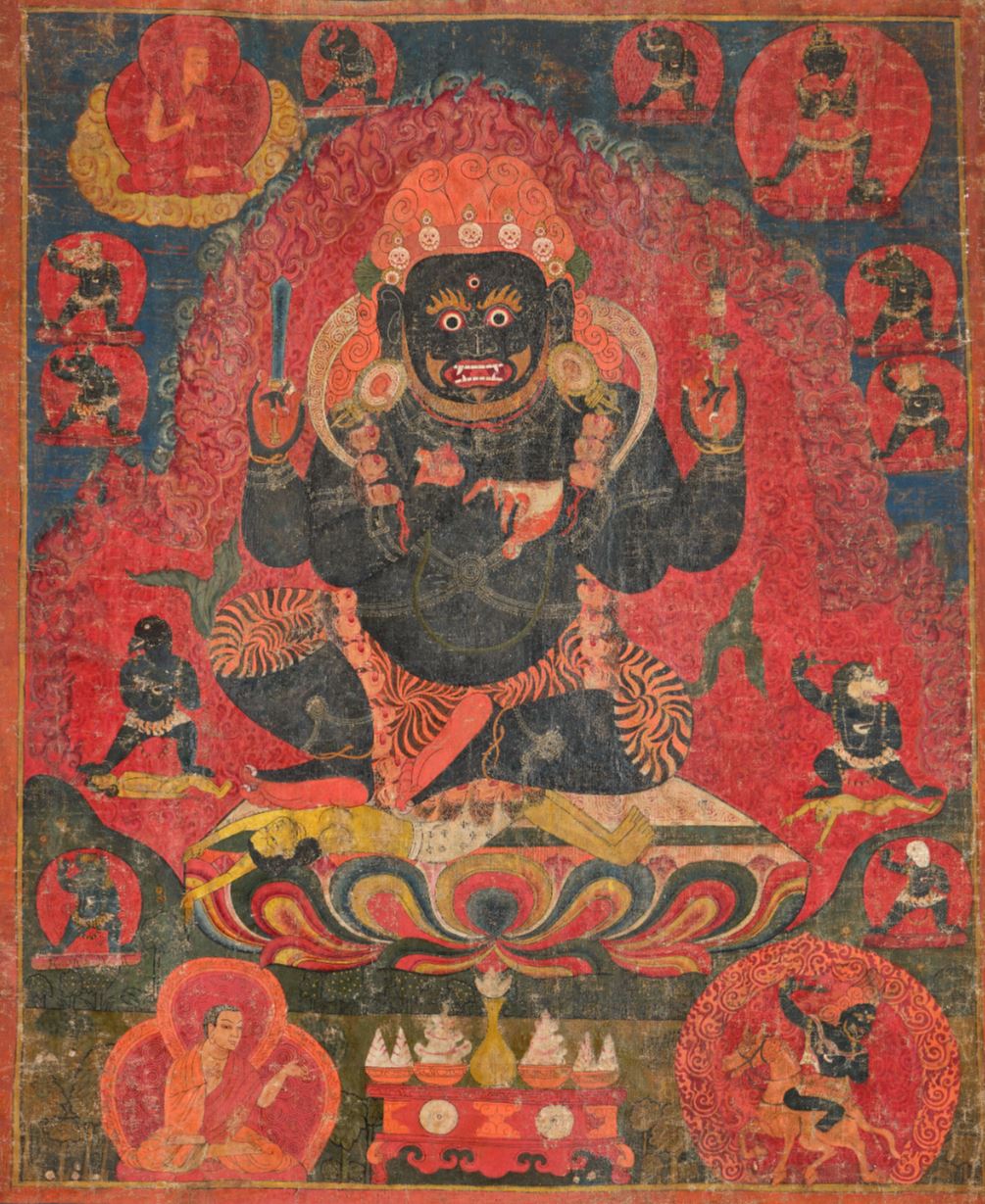
A THANGKA OF CHATURBHUJA MAHAKALA WITH RETINUE
TIBET, 15TH CENTURY
Distemper on cloth with new mounting.
Image: 62 x 52 cm (24 1/2 x 20 1/2 in.);
With silks: 104 x 53.5 cm (41 x 21 in.)
Footnotes
Provenance
Acquired in 2014
Eleven years in the Collection of Ulrich von Schroeder
西藏 十五世紀 四臂大黑天及眷屬唐卡
來源
2014年入藏
烏爾里希·馮·施羅德珍藏,十一年
This powerful thangka depicts four-armed Chaturbhuja Mahakala, the wrathful emanation of Avalokiteshvara and protector of the Chakrasamvara Tantra. Seated in lalitasana upon a lotus pedestal and framed by a vivid red flame aureole, he raises a sword and khatvanga in his upper hands, while his principal hands wield a vajra-handled chopper and a kapala. Above, a red-hatted Sakya hierarch faces Samvara with Vajravarahi. In the lower register, Sri Devi crosses a sea of blood opposite a donor monk, flanking a table of torma offerings. Immediately surrounding the central figure of Mahakala is a retinue of ten animal-headed attendants, which includes the eight Simhas or Pisaci:
1. Simhasya or Simhamukha = seng ha mu kha (lion face)
2. Vyaghrasya or Vyaghramukha = bya kri mu kha (tiger face)
3. Sṛgalasya or Shṛgalamukha = sri la mu kha (jackal face)
4. Shvanasya or Shvanmukha = shwa na mu kha (dog face)
5. Grdhrasya or Grdhramukha = kri ta mu kha (vulture face)
6. Kankasya or Kankamukha = kang ka mu kha (heron face)
7. Kakasya or Kakamukha = khwa kha mu kha (crow face)
8. Ulukasya or Ulukamukha = hu lu mu mkha (owl face)
The painting reflects the evolution of Tibetan art in the late 15th century, where the established Newar Beri style blended with new stylistic currents. Beri traits – geometric scrollwork in backgrounds and aureoles, a bold red ground, and a jewel-toned palette of crimson, blues, and greens – are combined with innovations such as floating secondary figures no longer in strict registers, a simplified green foreground with a little foliage and a deep blue sky, anticipating the increasing adoption of Chinese landscape elements in the 16th century.
These characteristics recur in several 15th-century Tsang thangkas. A Virupa painting in the Rubin Museum of Art, New York, (F1998.11.1; HAR 641) features the same black outlining to its foliage, intricate scrollwork, and rich palette. A thangka of Sachen Kunga Nyingpo (HAR 944) in a private collection pairs vibrant red and orange scrolling aureoles with spacious, uncluttered upper register. A second Sachen Kunga Nyingpo example (HAR 41028) combines Beri-style ornamentation and palette with registers of floating secondary figures. Together, these parallels firmly place the present painting within the output of Tsang workshops serving monasteries such as Sakya, Gyantse, and Ngor.