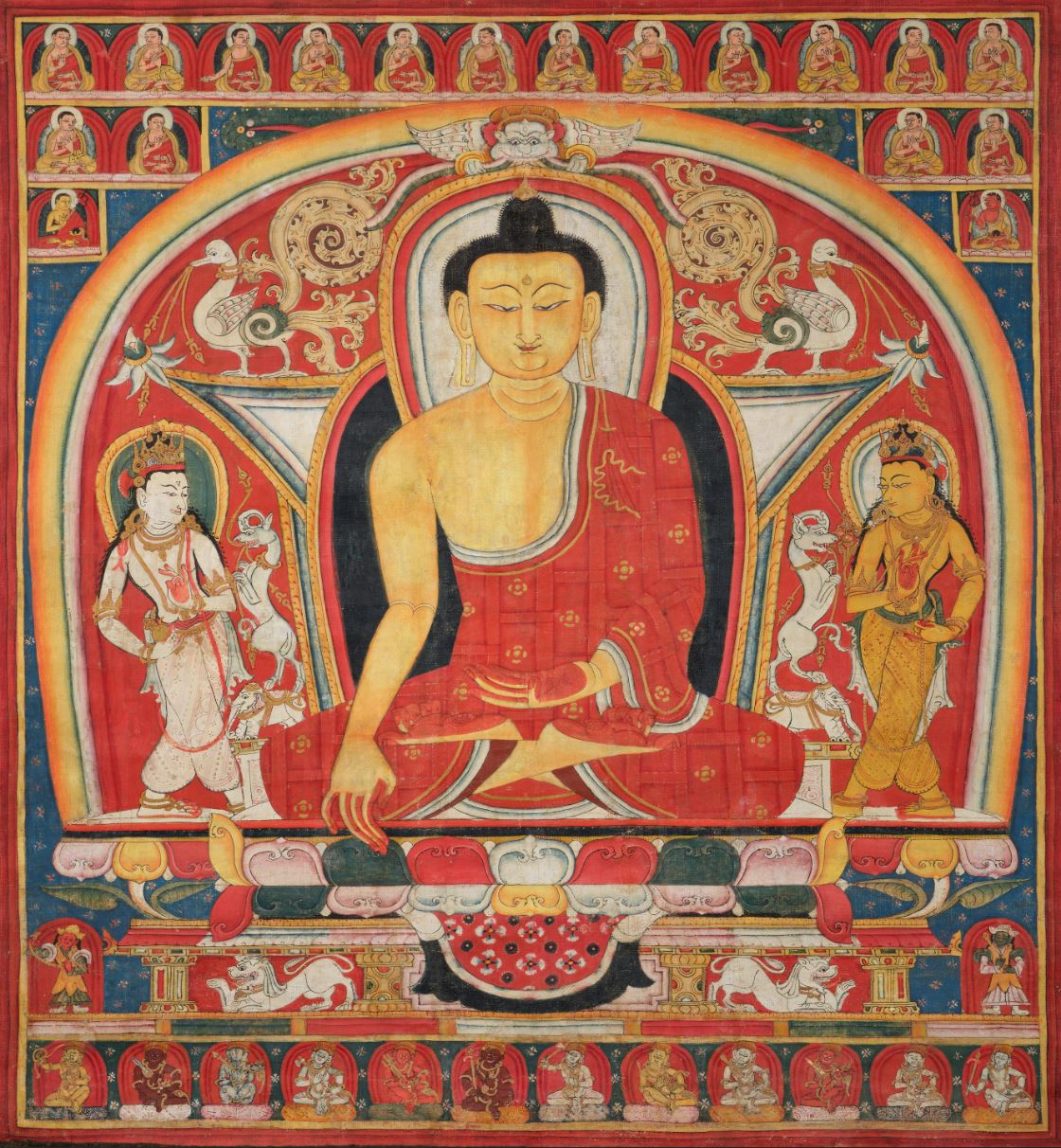
A THANGKA OF SHAKYAMUNI BUDDHA
WEST TIBET, 13TH CENTURY
Distemper and gold on cloth; verso with the outline of a stupa in red ink.
Himalayan Art Resources item no. 2808
Image: 42 x 40 cm (16 1/2 x 15 3/4 in.);
With silks: 78 x 48 cm (30 3/4 x 18 7/8 in.)
Footnotes
Published
S.V.D. Schulenburg, E. Hessel, K. Schmidt, M. Wagner (eds.), Buddha, Museum Angewandte Kunst Frankfurt am Main, Cologne, 2015, cat. no. 87.
Meinrad Maria Grewenig & Eberhard Rist (eds.), Buddha: 2000 Years of Buddhist Art, 232 Masterpieces, Völklingen, 2016, pp. 360-1, no. 153.
Exhibited
Buddha: 2000 Years of Buddhist Art, 232 Masterpieces, Völklingen, 24 June 2016 — 19 February 2017.
釋迦牟尼唐卡
藏西 十三世紀
布面設色並金彩;背面繪紅色佛塔線稿
著錄
S.V.D. Schulenburg,E. Hessel, K. Schmidt 及 M. Wagner 編,《Buddha》,Museum Angewandte Kunst Frankfurt am Main,科隆,2015年,圖錄編號87
Meinrad Maria Grewenig 及 Eberhard Rist 編,《Buddha:2000 Years of Buddhist Art,232 Masterpieces》,弗爾克林根,2016年,頁360-1,編號153
展覽
「 Buddha:2000 Years of Buddhist Art,232 Masterpieces 」,弗爾克林根,2016年6月24日至2017年2月19日
Seated on a lion throne and encircled by rings of prismatic light is the Buddha Shakyamuni, who is seen here with his right hand in the touching earth gesture (bhumisparsha mudra). Standing on the left is Maitreya, the white-skinned bodhisattva who loosely suspends a waterpot from his hand, and on the right, the yellow-skinned Manjushri with a tendril and flower over his right shoulder. Mythological animals adorn the throne, including two elephants, two vyalas, two wild geese holding golden vines, and a winged Garuda at the apex. The register behind the throne shows two projecting branches alluding to the bodhi tree under which the Buddha attained enlightenment. A small congregation of eighteen monks joins the Buddha, located in the upper portion of the thangka, each encased in a red throne back and holding various mudras. Twelve worldly guardians feature in the tier beneath the lotus-lion throne. They symbolize the all-encompassing power to repel evil and bestow wealth to devotees, each holding various attributes including a noose, sword, battle-axe, and khatvangha.
The art of Kashmir and eastern Nepal influenced the style of this painting from West Tibet. The treatment of the figures' heavy eyelids and the long braided locks trailing down the bodhisattvas' shoulders follow Kashmiri attributes comparable to sculptural examples including one circa 10th Avalokiteshvara (von Schroeder, Buddhist Sculptures in Tibet, Vol. I, 2001, p. 183, no. 53B). The influence of Nepalese manuscript pages appears in the blue background peppered with floating flowers, the multi-lobed crown of the bodhisattvas, and the floral decorations along the Buddha's robe. Influential prototypes of Buddhist deities are illustrated on a Nepalese manuscript of the 11th century (fig. 1; The Metropolitan Museum of Art, New York, 1976.192.1, .2).
The syncretic style of West Tibet is primarily associated with the Guge kings who ruled the region beginning in the 10th century. A painting in the Cleveland Museum of Art (fig. 2; 2000.68) from western Tibet, attributed to the 12th century, depicts Amitabha with an almost identical facial type and styling of hair to the Buddha in this thangka. The flanking bodhisattvas in both images show a similar treatment of their hair and body posture. The art of Mustang, in modern-day Nepal, shares several idioms with that of West Tibet. A mural of the Buddha in Luri cave (HAR 47545) features a similarly shaped hem across the Buddha's chest and triangular projections along the throne back. The similarities between this Buddha and the Cleveland and Mustang examples articulate the emergence of a style that builds on its early Kashmiri influences while incorporating elements of the broadly known Newar influences in Tibet.