拍品编号:PMJG4575
拍品名称:大威德金刚 胜乐金刚 密集金刚
拍品年代:18-19th
拍品尺幅:86 * 169(厘米)
成交金额:
15,360 USD
折合人民币:15360 USD
拍品类型: 金唐
拍品地域:西藏
拍品材质:布
拍品主题:人物(复数)
拍卖公司:Bonhams(邦瀚斯)
拍卖专场:INDIAN, HIMALAYAN & SOUTHEAST ASIAN ART(2025-03)
拍卖时间:2025年3月
拍卖地点:纽约
原始编号:322
内容:
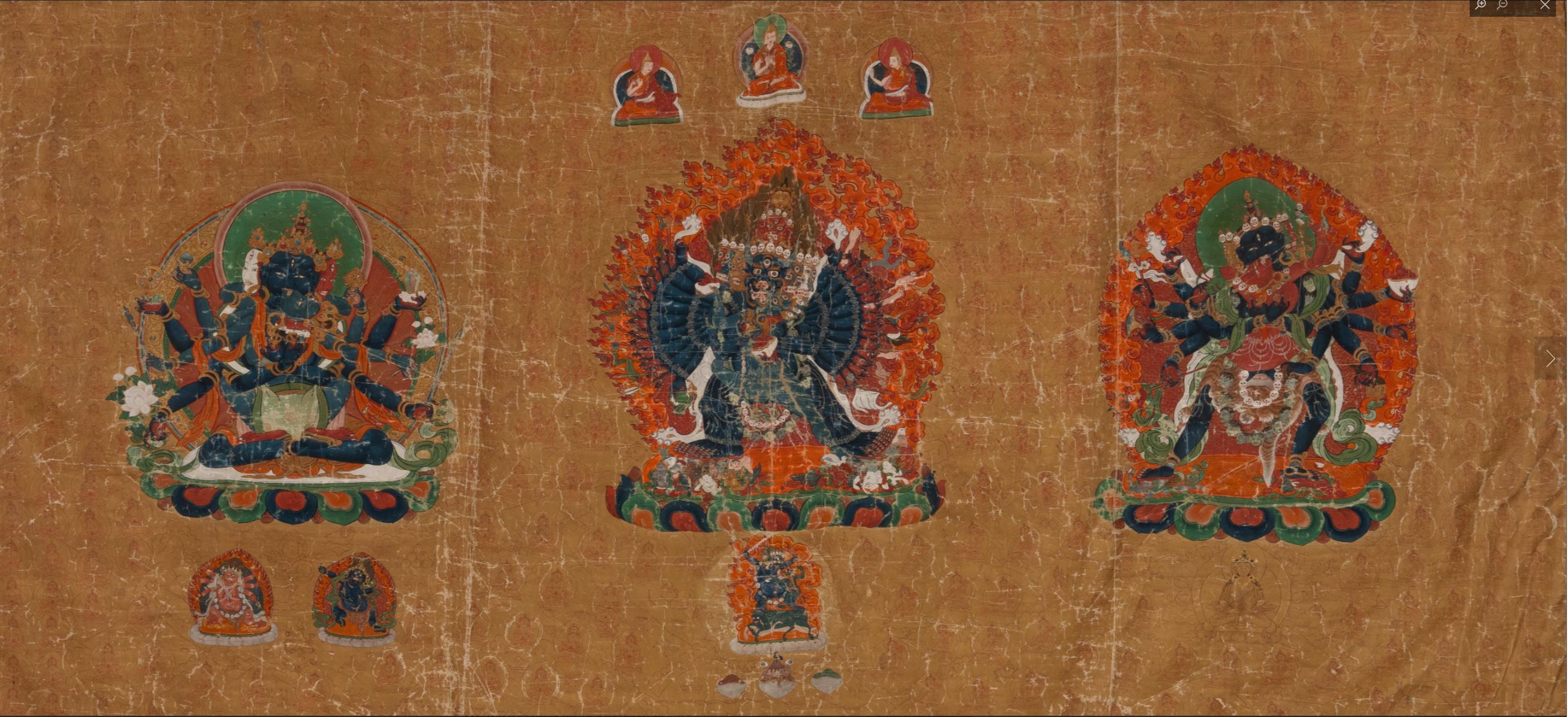
A GOLD GROUND THANGKA DEPICTING VAJRABHAIRAVA AND CONSORT
TIBET 18TH/19TH CENTURY
Distemper and gold on cloth; with original silk brocade mounts.
Inscribed on the verso in black ink with the following mantras and prayers, translated:
For the sake of all beings, I become Heruka,
May all beings be placed in the supreme state of Heruka.
Om Suprathishta Vajra Ye Swaha!
The vastness of the sky is like the master of the five kayas,
Who realized the ultimate state,
May all the beings be placed in that very state with ease,
Worshiping the Buddha and listening to the Dharma,
Practice the ten Bhumis to become a master of the five kayas,
Attain enlightenment in the pure realm, to guide all beings through various manifestations.
Om Suprathishta Vajra Ye Swaha!
The virtuous action of making this glorious Guhyasamaja Buddha Akshobhya along with surrounding deities,
Is dedicated to the accumulated merits of all the beings,
May I, along with all beings attain the state of the four kayas of union.
After achieving the ultimate state,
Appearing in countless manifestations,
The one who holds all the Buddha's teachings,
May he liberate all the beings from the ocean of cycles.
Om Suprathishta Vajra Ye Swaha!"
Himalayan Art Resources item no. 2832
Image: 34 x 66 1/2 in. (86.4 by 169 cm)
With silks: 51 1/4 x 78 1/2 in. (130.2 by 199.4 cm)
Footnotes
金地大威德金剛及明妃唐卡
西藏 十八/十九世紀
Provenance
Private American Collection, acquired in Nepal, 1968
Thence by descent to the present owner
This large horizontal depicts three boldly rendered tantric deities on a gold ground. At the center is Ekavira Vajrabhairava with his consort Naro Dakini framed in an aureole of licking flames. Above the central figure, in smaller scale, sit three Geluk lamas. Below, standing on the spine of a buffalo is protector Yama Dharmaraja. To the left sits Guhyasamaja in union with his consort Sparshavajra surrounded by halos of red and green encompassed in a rainbow-hued orb. Protecting this deity are small representations of Hayagriva and Vajrapani. Blue-bodied Chakrasamavara stands to the right, wearing garlands which wrap around his red-bodied consort, Vajravarahi. Below, the peaceful Buddha Amitabha sits in gold. Repeated images of the goddess Tara, outlined in red ink, are set against the gold background.
The format and style align with Qing modalities. This thangka's horizontal format follows compositions commonly painted on walls in monastic chapels and was popular within the Gelug order since at least the 18th century. The arrangement was possibly inspired by the imperial Qing workshop, which produced examples now held in the Palace Museum, Beijing (Wang [ed.], Zangchuan Fojiao Tangka, Hong Kong, 2006, pp. 262-285, nos. 240-263). Moreover, the choice of gold ground follows a tradition of laying images directly onto Chinese gold silk. Other examples featuring boldly colored figures on gold ground with repeated outlined figures include a thangka of Tangtong Gyalpo (HAR 21792); a Vajrapani thangka (Bonhams, New York, 14 March 2016, lot 33; and another example illustrated in The Complete Collection of Treasures of the Palace Museum, Hong Kong, 2006, p. 108, no. 98.


 查看更多
查看更多 