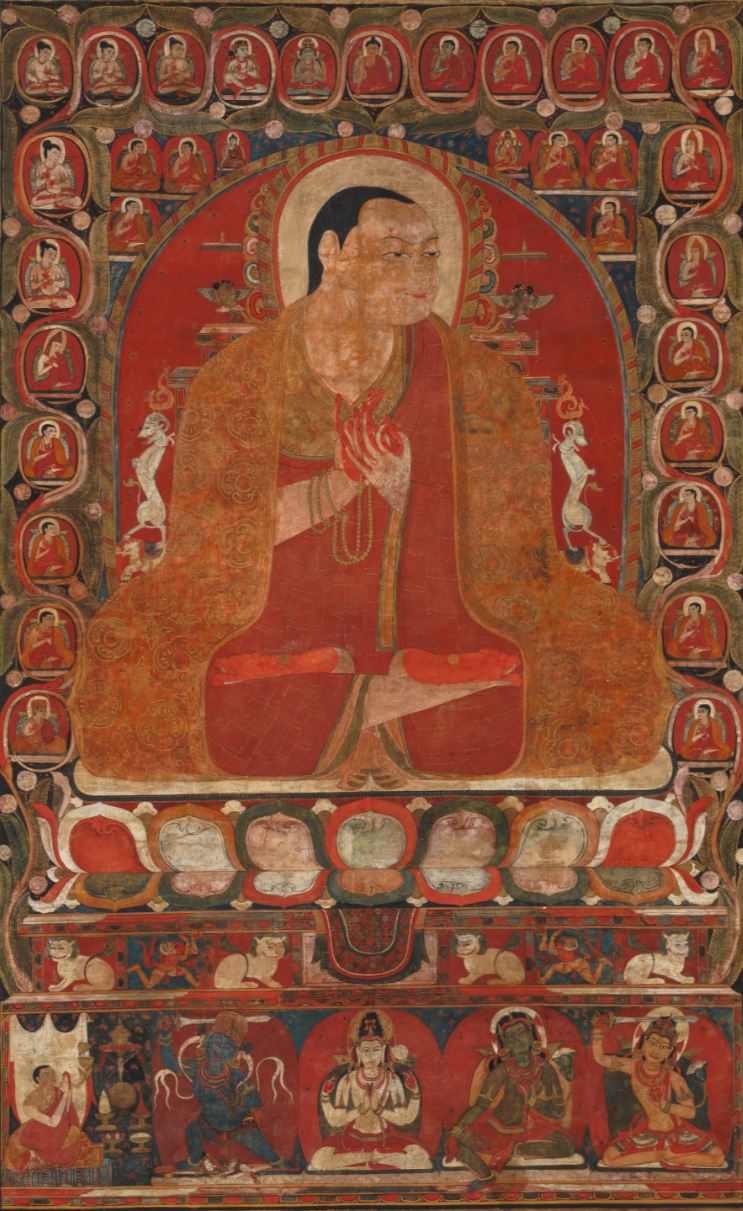
拍品编号:PMJG4564
拍品名称:上师 CHENNGA TSULTRIM BAR
拍品年代:12-13th
拍品尺幅:132 * 82(厘米)
成交金额:
76,700 USD
折合人民币:76700 USD
拍品类型: 彩唐
拍品地域:西藏
拍品材质:布
拍品主题:人物
拍卖公司:Bonhams(邦瀚斯)
拍卖专场:INDIAN, HIMALAYAN & SOUTHEAST ASIAN ART(2025-03)
拍卖时间:2025年3月
拍卖地点:纽约
原始编号:303
内容:
A PORTRAIT THANGKA OF AN EARLY TIBETAN TEACHER,
POSSIBLY CHENNGA TSULTRIM BAR
LATE 12TH/EARLY 13TH CENTURY
Distemper and gold on cloth; verso inscribed with abraded consecrations in red Tibetan script.
Himalayan Art Resources item no. 1846
52 x 32 1/4 in. (132 by 82 cm)
Footnotes
西藏上師肖像唐卡 或為京俄瓦
十二世紀晚期/十三世紀早期
Provenance
European Collection
Chino Roncoroni, 2017
The Richard C. Blum and Senator Dianne Feinstein Collection
At the center of this painting sits a grand lama. He wears the red and orange robes of an ordained teacher and holds a mala draped through his hands as they unfold in the gesture of teaching. His face turns to the left in a three-quarter profile, exposing a rounded and broad chin. He is surrounded by diminutive deities, Indian siddhas, and Indian and Tibetan monks wrapped in orbed leaves set against a blue background of floating flowers in a style that recalls Indian manuscripts and in a format that designates early Tibetan portraiture of great masters as enlightened beings. The iconography and style parallel dates to other lama portraits of the late 12th/early 13th century, although both the lama's identity and associated order remain an enigma.
Due to shared features with another lama portrait at the Metropolitan Museum of Art (1991.152), the subject of the painting has previously been identified as Chennga Tsultrim Bar (1038-1108), a teacher of the Kadam school. Both images have similarly balding pates, a pronounced jawline, and hold malas between their fingers. The identification of the Metropolitan Museum painting originates from the inscription at the back which names Chennga Tsultrim Bar and references its intended placement. Interpretations of the inscription by David Jackson suggest that Chennga Tsultrim Bar is not only the consecrator, but also the subject of the portrait. (Jackson, Mirror of the Buddha: Early Portraits from Tibet, New York, 2011, p. 71-73, fig. 3.3). In the same publication, he also remarks that the figure remains unidentifiable, though is likely a monk from the Kadam order (ibid, 2011, p. 38, fig. 2.30). This correlates more closely to what Casey articulates, concluding that although there are no distinguishing features to clearly identify the figure, Tsultrim Bar's name historically associates the lama to the Kadam order (Casey, Taklung Painting: A Study in Chronology, Vol. I, 2023, p. 126-130). If the assumption is that these two portraits represent the same lama based on the parallels in physiognomy and placement of the mala, then it would also assume this lama's connection to the Kadam order.
The inscription along the verso of this painting is too worn to find any consecratory clues, and there are other known examples of lamas holding malas as well (ibid, Vol. I, 2023, p. 208, no. 12), giving an even more limited scope in the identification of this lama. This leaves the accompanying retinue as indicators of the figure's lineage and associated order. In the outer registers along the top and sides emanating from Maravijaya Buddha and a Vajradhara at center are six mahasiddhas, eight Indian monks who can be identified by their exposed shoulders, eight Tibetan monks who wear sleeveless vests beneath their outer robes, and one Tibetan monk wearing an unusual flat hat. Appearing along the throne back above the lama's shoulders are six more monks, three of Indian origin and three dressed in the Tibetan style. One of the Tibetan monks with a darkened beard resembles Phagmodrupa, although no other Kagyu lineage figures appear in this painting. Neither though does Dromton, the main teacher of Chennga Bar and original disciple of the great Indian master Atisha (982-1054). His distinguishing features of layman's robes and curly locks do not relate to any of these subsidiary figures. While lineage ties remain vague, there is a clear integration between both Indian and Tibetan monks, correlating to a period of revival of Buddhist teachings in Tibet beginning in the 10th century. To establish this Buddhist foundation, Tibetans looked towards the purity of the teachings from its motherland in India.
Much of the credit for establishing this foundation of monastic culture in Tibet, and subsequently visual tradition was the great Indian master Atisha. It is documented that Atisha commissioned several paintings from Vikramashila monastery where he was a senior hierarch. One such surviving manuscript from the monastery in Bihar dated to the 12th century, shows an apparent connection in stylistic rhetoric between the Indian painting tradition and this portrait (Kossak, Painted Images of Enlightenment, 2010, p. 28, fig. 15). The combination of Bihari and Bengali motifs, evident in decorations of the throne, the blue background, the application of palm leaves, and the lower register of deities derive from this Northeastern Pala tradition. The throne setting bearing an alternating red and blue oblong semi-circle motif along the cornices correspond both in pattern and in design to the Tara image from the manuscript. In a leaf from a 10th century manuscript depicting the Buddha's birth and an allegory of generosity (University of Cambridge Library, http://cudl.lib.cam.ac.uk/view/MS-ADD-01464/256), the saturated blue background peppered with floating red flowers acts as the model for the similar color palette and floral design in the background of this painting.
Although the Tibetans emulated these authentic Indian styles, much of these iconographic and stylistic adaptions were employed as support for a growing monastic culture where the hierarch and his lineage were of dominating importance. Such a period included the founding of many, potentially hundreds of monasteries of great diversity at the time. All these nascent institutions were simultaneously putting emphasis on the role of the teacher as a point of reference for their ability to convey the authentic Buddhist teachings. Thus, depictions of great lamas portrayed in a hieratic scale of proportions alongside their spiritual lineages, as depicted here, "...illustrate the link between a teacher and an unbroken line of respected spiritual authorities, whose roots, ideally derived from the much revered Indian masters (Kossak and Singer, Sacred Visions: Early Paintings from Central Tibet, 1998, p. 14)." Such empowering imagery of largely scaled lamas painted with emblems of their spiritual enlightenment in conflation with those of the Buddha, not only link an emerging Buddhist culture to their Indian lineage, but also depict the Tibetan master as a manifestation of enlightenment itself.